
 |
|
|
|
 |
|
|
|
|
|
itzerl
|
|
Swami Veda’s 75th Birthday(s)!
|
|
|
|
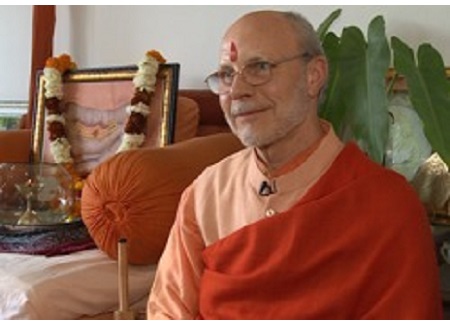
There was an air of conspiracy for nearly two weeks among the residents and guests of Sadhaka Grama. Swami Veda's 75th birthday was coming!
Swamiji had sometimes mentioned that his personal preference was to be left alone on his birthday. Many would smile understandingly as he would say this. But that was not to be this time around! A programme was chartered, the script prepared, artisans made inspired. There was much rehearsal of music and song. Poems were crafted in dormitories and rooms. The people had hard decisions to make - what to wear! The ladies got their best saris ironed. Special sweets were ordered. The stage was set!
Finally, the evening arrived.
A loving contingent was sent to invite Swami Ji to the Meditation Hall (for a ‘short talk’). As Swamiji came to the top of the steps, he gave a gasp of surprise!
There, in the darkness of the setting sun, were 75 diyas (open oil and wick clay lamps) lit along side the steps of his chamber to the Meditation Hall. Each diya was surrounded by gentle circles of rose petals. The diya lights softly danced on the petals, and on the radiant faces of those present. From the staircase door up to the altar of Swami Rama, a line of his beloved students stood on both sides of him, with palms filled with rose petals. As Swami Veda walked by with hands joined in humble prayer, the rose petals were showered on him.
As his usual reverent practice on entering the Meditation Hall, Swami Veda first paid homage to his Guru's image. He was then lead by the welcoming committee of children in colourful and bright Indian clothes to the front of the stage, to take his place on the saffron seat. As the audience settled in amid laughter and smiles, the program for the evening began.
Keeping with the current practice of starting each transition with the two-minute meditation, the crowd first sat in erect silence until the chant of Aum by Swami Veda.
Swami Atma, as the Master of Ceremonies, began with a salutation from his heart "in the presence of Swamiji, we feel truly in an ambience of motherly compassion and an eternal feeling of oneness”. He then introduced each performer of the evening with cleverly crafted prose.
Shruti Pushkarna set the tone for the performances by a sincere chant of the Guru Mantra followed by a talented rendering of two devotional hymns in praise of Lord Krishna.
Swami Sukhmitji along with a small band of Gurukulam students, then followed up with a Sufi styled chant on from the Granth Sahib - ‘let not even one breath go to waste, let me in each breath remember your name’. This was a follow on of the Nirmal Ashram group performing the same hymn a day earlier, which had members of audience in tears. True to form, Swami Sukhmit’s singing touched the heart, calmed the senses and evoked much reverence from the crowd.
Seamlessly, Shantaji from Canada then glowingly presented two more devotional songs.
We then had a novel presentation of kirtan, in the Hungarian language, by Sujata. With soul searching high tones, and mesmerizing melody she sang kirtan in praise of child Jesus (as it was the day of resurrection of Christ as well). Though this style of music was new to most, it had an immediate fan base in Rishikesh.
Then, Mrs Pamela from Trinidad presented a beautiful and loving gift to Swamiji. It was a letter to Swamiji that she enclosed in a sealed envelop. She said she was too shy to express so much emotion in public but she was keen to present her gift to Swamiji on his birthday. Swamiji read a few lines of the letter, and immediately called her close for a hug in return for her passionate verse.
Mrs. Geeta Adhikari and Bramachari Ramprakash, both Gurukulam students, kept the atmosphere loving and sweet by their rendered two more melodious songs.
The highlight of the evening's program was the dance performances by the internationally acclaimed Orissa dancer Jyoti Srivastava. Jyoti is an initiate and disciple of Swamiji and had with her a very talented troupe of young artists, who included Rahul Varshney, Isha Das, Ambalika Khanna, Suchira Basu, Sumana Basu. While Ananda Kishore introduced the various elements of dance recital, Sidharth Kishore sang a Vandana.
The performance was art and poetry in movement (literally, as Swami Ji explained that each word of the dictionary was mapped as a movement in this form of dance. Hence, it really was poetry in motion). The dancer shares his or her poem and compelling story by precise movements of the eyes, fingers and hands.
Later, during his speech to the audience, Swamiji shared that the dance item by Ms Srivastava on the divine stories brought tears to his eyes for the story that it told, and the beauty of its prose. He said he really wished he could let everyone share in the understanding and appreciation of such a magnificent, but little understood art.
Swamiji also expressed his joy and happiness for the pouring of love and affection for him. He admitted that he usually prefers to be left alone on his birthday, but that the recent flood of love and care had really touched his heart.
Swamiji also shared a concern of his, on how we sometimes limit our love and affection to certain people only. Instead, the love should be universally shared. He proclaimed that “if you really love me, then love each other. Love each other, as that is what will make me feel loved”.
He then thanked the key people of the night who had worked so hard for the event. He blessed everyone, and then gently retired to his chamber.
[Editor: Later on, when we tried to joke with Swamiji about reaching another milestone, he helped put things in perspective by saying “Well, how many 75th birthdays do you think I have had in the last million years? Or how many 75th birthdays did I have in the last million lifetimes or so? What is another one 75th birthday on that list!
(Gulp!) ….Ermmm. Yes Swamiji…Of course!
|
|
SVB’s Prayer... My Lord Of Love
|
|
My Lord of Love,
You have endowed your universe with immeasurable quantum of magnetic attractions
You have rendered the endless pull of measureless love between earths and suns by the trillion.
You have further filled the hearts of these earths and suns with such infinite kindness and affection that they never cease pouring the motherly milk of their glances into the vessel of my own heart.
I am filled and over filled and over flown not knowing where to pour these riches you have thus conferred upon me with your infinite grace.
All I can say to my friends, the fellow earths and suns, in a stuttering lisp, ‘ Please accept my infinite gratitude for all of the times you presented me your gift jewels each time that my then current body turns 75. May your love return to you in a million fold magnitude whenever you celebrate the transitions of your life whenever and in whichever space you are born as an all sheltering earth or as an all brightening sun’.
Swami Veda Bharati
24 March 2008
|
|
The Ashram Has Fun On Holi
|
|
|
|
21 March this year was a very special day.
It was the Spring Equinox, when the day and night are equal, that according to Tantra is the in breath and out breath of nature being equal.
It was the Full moon with beautiful meditations.
It was the Spring harvest festival in India, the end of the forty days of Spring celebrations.
It was Holi, the festival of colors, the day all hierarchies are abolished, all transgressions are forgotten and forgiven and those who had not been on speaking terms may visit each other and embrace without ‘loss of face’.
It was also the birthday of the Prophet Mohammad as well as the anniversary of his death.
It was Good Friday.
It was Jamshedi Navroz, the new year as celebrated by the Zoroastrians both in India and Iran.
It was the first day of Purim, a Jewish holiday of carnivals, charity and eating Hamentashen, the evil Hamen’s hats.
The huge bonfires lit at the centers of towns and villages use the year’s discards of households as kindling. Along with that burns all that may be discarded from the mind such as hostilities and fears of each other.
The first fruit of the harvest is thrown in the fire, roasted and shared.
Most important, every household buys, makes and shares ample amounts of Gujiyas, a crescent shaped pastry filled with nuts and milk solids.
The ones that our Swamiji orders made are always extra large and fit for the Guinness Book of Records.
Guests and students from twelve countries participated in the celebration.
The celebration began at 8 pm. Sanskrit prayers were said for the deities of the earth and fire and with appropriate consecrations.
The children of the campus and the guests were having a great time running around and rubbing colored powders on each other.
Swamiji sat on a chair and everyone came by; Swamiji rubbed colored powder or sandalwood paste on their foreheads, they received a blessing and, more important, large-sized Gujiyas were given to all.
Many people danced around the fire to special drum beats of the occasion and sang songs in Hindi and Garhwali.
The 22nd of March began with morning meditation followed by the bright, splashing colors and fun of Holi, with everyone rubbing colors on each others’ cheeks. The gurukulam students sang Holi songs to the beat of drums and tambourines. They went to each room and cottage of the Ashram inviting the guests and residents to play colors. The colors on the cheeks reflect on the mind, the earth and the sky, making it even more colorful.
Then the entire group walked from Sadhaka grama to Sadhana Mandir Ashram beating the special rhythms of holi on their drums. After that many of them jumped into the cold Ganga to cool the fervor and at the same time to wash off the colors.
|
|

by Lalita Arya
Director of KHEL Charities
www.khelcharities.org
|
|
A Brief History of the Tamil Language
|
|
If you ever come to India and look at her currency you will be amazed to note that the amount of the currency note is written in 14 different languages. Tamil is one of those languages. Though not well known in the north of India it has a very rich tradition in the south. I am very grateful to Dr. Saroja, a retired Neuro-Pathologist, who is well known to me and has graciously written this article to enlighten our readers of the rich and varied cultural history of a land that is known as Bharat, India
Tamil Saint - Sant Thiruvalluvar
A Brief History of the Tamil Language.
Dr. Saroja Ilangovan
Tamil is a Proto-Dravidian language, with an age of over 3 millenia, and is the only language in India, with the exception of Sanskrit, that has an ancient past and a rich tradition of literary, cultural and spiritual history.
Many of the Proto-Dravidian languages such as Kolami, Parji, Naiki, Gondi, Ku, Kuvi, Konda, Malta, Oroan, Gadba, Khurukh and Brahui are still spoken by isolated small groups. A section of people living in Baluchistan still speak Brahui. Scholars have found many similarities between Tamil and Brahui, especially in numerals, personal pronouns, syntax, and other linguistic features. This goes to show the influence of Tamil not only in the sub-continent but as far as the north west frontier. In the historic past, Proto-Dravidian was spoken throughout India.
When Prakrit and Pali became popular in the North, the Proto-Dravidian language lost its ground there, and confined itself entirely to the South. Even in South India, it did not remain as a single language for a long time.
There was a political division of the Tamil country into three distinct Tamil kingdoms by natural barriers such as rivers and mountains. Eventually because of a lack of proper land communications and the influence of the Sanskrit language, dialectical differences appeared and four languages: Telegu, Malayalam, Kannada, and modern Tamil were formed. Tamil language has a long literary tradition. Earlier in the history many of the rulers in the present Telegu, Karnataka and Kerala regions were Tamil kings.
The term Dravidian, which refers to the language of South India, is of a later origin. Originally, it was derived from the word Tamil. The word in course of time changed into Dravida after undergoing a series of changes like Tamila, Tramila, Tramita, Trapida, and Travida.
Tamil, apart from being spoken by millions of people in TamilNadu, is a spoken and written language of several millions of Tamils living in Sri Lanka, Burma, Singapore, Malaysia, Indonesia, Fiji, Mauritius, South Africa, and in many other countries including the United States.
From Tamil literary sources and account of foreign travelers, it was evident that Tamils were well advanced in sea-borne and inland trade. Even as early as the tenth century B.C., articles of trade such as peacock feathers, elephant tusks,(now banned) and spices intended for King Solomon were sent in ships belonging to the Tamil country.
Iron age finds in the Phillippines also indicate the existence of trade between Tamil Nadu and the Phillippine islands during the ninth and tenth centuries B.C. Similar trade connections existed between China, Burma, Malaysia, Thailand and Indonesia
Among the ancient grammatical works available, the Tolkappiam was the earliest written around the third century B.C. There are over two hundred and fifty references in the Tolkappaiam which provide substantial evidence of the existence of many classical and grammatical works in Tamil prior to the Tolkappiam itself. Sangam period Tamil epics are mainly of two groups which are Ettuthokai and Pathu Pattu. Ettuthokai comprises eight collections of Tamil literature. Pathu Pattu has ten collections of Tamil literature. Sangam period is before Christ was born. Post Sangam period literature are Pathinenkeel Kanakku which comprises Thirukkural, Naladiyar, etc. Five great Tamil epics are written during the post Sangam period. Chilapathikaram, Manimekalai, Kundalasekesi, Valiayapathy and Seevagachinthamani. Several poets, mainly, Ilango Adigal, Ouaiyar, Nakkerar are some of the many who can be mentioned. The Holy Scripture period writers were Thevaram, Thiruvasagam, Nalayira Divya Prabandam during the 6th to 9th century A.D. Of all the Tamil works Thirukkural is still applicable to the daily life of human beings regardless of ethnic, cultural, religious and social divisions.
The poet Thiruvalluvar who wrote this great work addresses the universal human community for its upliftment, and brother and sisterhood. Thirukkural is comprised of 1330 couplets which focus on moral character, wealth accumulation and distribution, and life of love. Thirukkural is 2035 years old. Tamil people treasure this work and try to adopt its wisdom into their everyday life. Thirukkural has been translated into more than 100 different languages. Some of its simple teachings are relevant to daily life and that is why it is so honored by all who read it. Thirukkural states that “Love and Virtue are the flowers and fruits of domestic life” that “The just and the unjust shall be known by what they leave behind.”
Dr. Saroja Ilangovan is a retired Neuro-Pathologist. She is very much involved in the spread of the Tamil language and culture among youths and adults in the USA. She lives with her family in Pennsylvania, USA.
Check out our website: www.khelcharities.org
|
|
HYT-TTP News
|
|
News from the HYT-TTP office in Rishikesh
Swami Rama Sadhaka Grama hosted two training sessions of the HYT-TTP during the months of March and April. In those two retreats, a total of 41 students received certificates of participation.
The first training was held between March 2nd and 16th. Seventeen students received the precious teaching and guidance of Swami Ritavan, Maya, Ashutosh, Peter, Vishnu and Swami Atma. Two TTP graduates also joined the HYT-TTP international faculty for that event. The level one students attending the session had the privilege to be taught by Marilou Hermens (TTP Graduate - 2005) and Sonia van Nispen, also general secretary of AHYMSIN (TTP Graduate - 2007), both coming from Holland especially for the occasion.
That training also witnessed a strong increase in the number of Indian students coming from outside the ashram to join TTP. A total of six Indian students were present, coming from as far as the states of Punjab and Uttar Pradesh.
Even if Swamiji was not physically present at the ashram during the training, his presence was strongly felt throughout the two weeks.
The second training was held from March 24th to April 4th. This session was a very special one, as a group of 24 students came from Taiwan in association with the Chinese Youth Corporation. With Ashutosh back in Europe to teach, Swami Ritavan, Maya, Peter, Swami Atma and Vishnu were present to impart the teaching to all the very nice and friendly Taiwanese students.
Swami Veda distributed the participation certificates to all the students and in a gesture of gratitude to him, all the participants sang traditional Chinese songs in the honor of Swamiji.
Please congratulate the new teachers in-training and provide them with your support! A list of their names is provided below.
We also would like to proudly announce the graduation of seven new students who have now completed the HYT-TTP program and have successfully gone through all the examinations and evaluations. There names of the new HYT-TTP graduates are:
- Mary Bowman-Cline, from Minnesota
- Daniel Hertz, from Minnesota
- Chuck Linke, From Oregon
- Willem Meijer, from Holland
- Louella Gerritsen van Bakel, from Holland
- Kye, Mi Ryang, from Korea
- Choi, In Sook, from Korea
Please visit our new TTP web site at www.himalayanyogatradition.com and join Swami Veda and the HYT-TTP faculty at Rancho la Puerta www.rancholapuerta.com in Mexico in August. You can come for a TTP training session or for a spiritual retreat in a breath taking environment.
For more information on the Himalayan Yoga Tradition – Teacher Training Program, please contact the Rishikesh office of HYT-TTP at the following email address hyt.ttp@gmail.com or info@himalayanyogatradition.com
March 2007 Teachers in-Training
Name Country Level
- Anil Trikha India One
- Vani Shukla India One
- Theo Gielis Holland One
- Gajendra Badwal India One
- Ramdev Chakradhar India One
- Rekha Rani India One
- Richa Yadav India One
- Zsuzsanna Hajdu Hungary One
- Nicolle Schyns Holland One
- Crista Eikens Holland One
- Constance van Vliet Holland One
- Winthrop Harewood Trinidad One
- Pamela Khudan Trinidad Two
- Nancy Neede Holland Two
- Ada Torton China Two
- So Mei wan Hong Kong Three
- Irma de Boer India Three
Taiwanese Level One Students
Lee, Yi-Miao Jen, Wei-Hui Ho, Wan-Ju Li, Chun-Fang
Lee, Kuei-Lien Lin, Shu-Chin Chang, Chiung-Pin Liang, Hsiu-Ling
Chuang, Su-Chao Chen, Ya-Wen Tseng, Hui-Ling Huang, Cheng-Hsun
Kung, Li-Yin Huang, Yun-Ju Ou, Pei-Chun Cheng, Su-Chen
Tai, Hsiao-Mei Hsueh, Chin-Lien Su, Hsiu-Ning Wang, Hsueh-Yen
Lin, Ling-Ji Lin, Yi-Ting Hsu, hung-Ying Siauw, Fei
|
|
How HYT-TTP is serving AHYMSIN
We would like to invite you to become a volunteer in the TTP organization.
Let us take a moment to explain how the TTP organization is developing to better serve the larger AHYMSIN Family.
Our mission as defined by Swami Veda is:
- 1. To work for spiritual liberation for as many beings as we are capable of helping,
- 2. Maintaining the pure spirituality and meditation teaching in such a way it carries on into the future generations,
- 3. Extending and expanding the teaching of the yoga and meditation as taught by the Himalayan Masters as interpreted by Swami Rama.
Our major goals are to provide the support structure to serve this mission, by encouraging:
- q AHYMSIN Members to become Teachers. Swami Veda has said, “Teach and be blessed. Teach and your sadhana will progress.”
- q TTP graduates to support or build local AHYMSIN centers to train the future generation.
- q AHYMSIN (long time practitioners) Members to become mentors to teachers-in-training to provide the 1-to-1 attention that is essential to our tradition.
- q AHYMSIN members to provide volunteer services to extend and expand the program.
- q Yoga teachers from other traditions to study the Himalayan Tradition and if appropriate to become AHYMSIN members.
The Support Structures that we are developing:
- 1. Communication System – web based network for student teachers, mentors, teachers to discuss the “hows and whys” of all aspects of teaching yoga and meditation in our tradition from Foundations to Sadhana to Instruction and Integrated Practice. The system includes oversight by AHYMSIN family sadhakas who will monitor the discussions to provide insight and when necessary will forward questions to the AHYMSIN spiritual committee.
- 2. Student/Mentor System – a web assisted roadmap to guide the student and their mentor as the student progresses through an intensive home study. Most of the materials (monthly assignments, audio lectures, lecture transcripts, articles, booklets) will be in an online library. A process is outlined for a suggested set of mentor/student meetings providing the topics to be covered, resources to support the topics, and a recommended feedback methodology.
- 3. Teacher Sharing System – web based library to support the sharing of teaching materials between and among AHYMSIN teachers.
- 4. Public Awareness - publicize the Himalayan Yoga Tradition though representation at conferences, mailing brochures, and providing an engaging public web site that introduces: our tradition, our teacher training program, our centers, our teachers, our retreats, and our bookstore.
- 5. Administrative Office – located in Rishikesh and supported through web systems. Our goal is to ensure that there is one place where all issues and needs for the program can be handled.
- 6. Financial System – ensure that the program is financially responsible and self-supporting.
- 7. Student Data Base – web based system to ensure that each student’s record is carefully maintained and monitored to provide the student with the confidence to ensure successful progression in the program and to graduation.
Current Retreat Schedule:
|
|
Click here ==> http://www.swamiveda.org/full_moon_dates.html |
|
Magazine Article by Swami Veda Bharati
Indian Psychology - part 12
MIND-FIELD : THE PLAYGROUND OF GODS
|
|
DEPARTMENTAL EMAIL DIRECTORY:
ASSOCIATION OF HIMALAYAN YOGA MEDITATION SOCIETIES INTERNATIONAL:
Present Office Director: Jorge Romero Additional: Carolyn Hume
Future: Carolyn Hodges
With staff of Office Assistants
ahymsin@gmail.com
MANDALA RECEPTION AND FRONT OFFICE:
S.P. Nijhawan, General Manager of SRSG (spnijhawan369@yahoo.co.in)
sadhakagrama@gmail.com (Guest info, reservations & bookings: Silvia)
dhyanamandiram@gmail.com (Accounts & book keeping, D.M.T. Office: Bhupi)
SWAMI RAMA DHYANA GURUKULAM:
Ma Radha Bharati, Academic Director
dhyanagurukulam@gmail.com (Gurukulam email contact)
rrsrsg@yahoo.com (Ma Radha’s own email)
AHYMSIN PUBLISHERS:
Bhola Shankar Dabral, Director
ahymsinpublishers@gmail.com (Publications and bookstore: Deepti)
dabralbs@gmail.com (Bhola’s own email)
SWAMI RAMA MEDITATION LABORATORY:
Present technician and lab development:
Manuel Fernandez manu4429@gmail.com (personal email)
HYT-TTP (HIMALAYAN YOGA TRADITION – TEACHER TRAINING PROGRAM)
hyt.ttp@gmail.com (Pierre at Rishikesh office)
www.himalayanyogatradition.com (Website)
info@himalayanyogatradition.com (Email)
|
|
Welcome to Swami Veda’s World-Wide Newsletter. Your photos and input are important to us, and we welcome news from any one of SVBs centers around the world. Send photos, and news items to the editor: dan@prideaux.com for inclusion in future editions. We hope you enjoy this edition, and we ask for your comments. Your friends may subscribe to this newsletter by filling in the data at www.swamiveda.org - as well as email address changes.
|
|
|
|
|
|
|
|